Note: Some of this repeats general information from the review of Life of Fred books for the elementary grades.
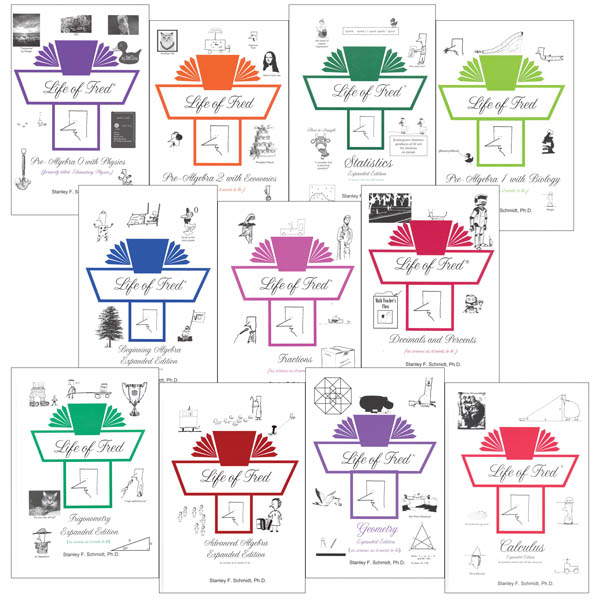
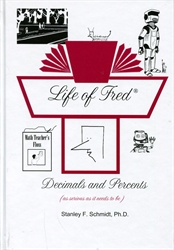
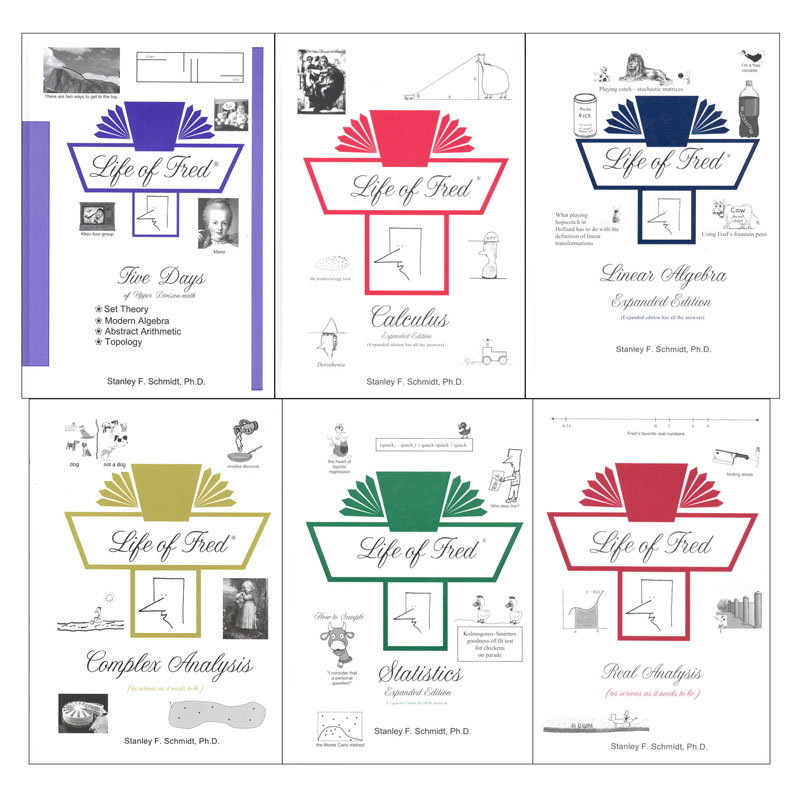
The Life of Fred series continues for students at least fifth grade and above with Fractions and Decimals and Percents. After Decimals and Percents, three books are used in what is usually considered the middle school years (grades 6-8): Pre-Algebra 0 with Physics, Pre-Algebra 1 with Biology, and Pre-Algebra 2 with Economics. They should be completed in that order and can easily be done in a couple of years. These texts treat physics, biology and economics just as they treat math, jumping from topic to topic with unusual connections to the storyline about Fred. Pre-algebra is covered in a scattered fashion along with a few more advanced concepts such as functions, calculating the molecular weight of sucrose, and balancing chemical equations. After these three texts, students move on to Beginning Algebra, Advanced Algebra, Geometry, Trigonometry, Calculus, and Statistics.
When I first heard about the Life of Fred series, I decided to start by reviewing the Geometry text since the homeschool market has a bigger lack of practical options in that area than in most other areas of math. So I'll provide general information about the series first then go into details beginning with a more-extensive review of the Geometry course followed by fewer comments about the other courses.
General Information
Two features immediately make the Life of Fred math series appealing to many families: low cost and courses designed for independent study. But there's much more to the Life of Fred books!
The books are written by Dr. Stanley Schmidt, a retired math teacher who loves math and wants to share his enthusiasm with students. Part of his strategy is to build his math books around the adventures of Fred, a very young (six years old in the Geometry text and five years old in the lower level books) genius who is a math teacher at Kittens University. The stories shift from silly to serious, outlandish to edgy. The Life of Fred books are likely to be very appealing to learners who work better with stories and situations to help them visualize math problems.
The story of Fred is very much a part of all the courses and the teaching method is pretty much the same from Fractions through Statistics. Most students should be able to work through all the books independently.
At least a few religious references indicate that the author likely has a Christian worldview, but there aren't actually any directly religious statements that I spotted.
All of the Life of Fred texts are hardcover books, printed in black and white. There are no separate teacher guides, but you should get the answer key or the Fred's Home Companion for the courses where they are available. The texts are non-consumable and might be used for a number of students.
Geometry
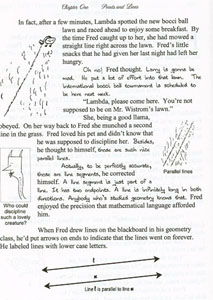
As in all Life of Fred books, Fred's adventures are the jumping off point for math lessons. For example, Fred plays with his food and creates a polygon, or Fred might be pondering something mathematical, or teaching, or discussing a math topic with friends. In the following excerpt Fred's pet llama, Lambda, lives with Fred in his office:
He [Fred] looked across the room in the semi-darkness toward what he called "Lambda's office" and hoped that she was resting well. "Maybe 18 miles was a little long for our first jog," he reflected. Fred had constructed her nest using some fencing that he had found in the general storage closet in the math building. The fencing formed the longest side (called the hypotenuse) of the right triangle (that's a triangle with a right angle) which was her part of Fred's office. The shorter two sides of a right triangle are called the legs. Since many of his students often visited Fred during his office hours, the use of Lambda's office as an example of a right triangle would be a perfect illustration to use in his geometry lecture today (Geometry, p. 92).
Dr. Schmidt digresses into footnotes, conversations, and side comments. All of this makes the text much more user-friendly than most others. It also adds a bit to the size of the book—542 pages for the Geometry text.
Surprisingly, the storyline and digressions are not used to dumb down the course. The geometry content is actually quite traditional, even though the presentation is not. The content is high level and challenging with proofs introduced in chapter one. Since Geometry is based upon definitions, theorems, and postulates, students are supposed to create their own notebook in which they write down each of these as they encounter them in the text. There's a reference section in the back of the book that has all of these presented in the order they are encountered in the book, but students should record definitions, theorems, or postulates each in their own sections of the notebook.
Each lesson teaches a concept, albeit sometimes in a roundabout fashion through the story. At the end of each section of Fred's story is a "Your Turn to Play," a set of practice problems with complete solutions. Students should work through all of these problems rather than jumping ahead to the solutions on the next page. There are a number of lessons with practice problems within each chapter.
There are six "extra" chapters (chapters 5 1/2, 7 1/2, 8 1/2, 11 1/2, 12 1/2, and 13 1/2) that can be skipped or included depending upon the student's ability and rate of progress.
At the end of each chapter are six sets of problems, each set labeled with the name of a city. Students should complete the first two "cities" (for which all solutions/answers are available in the student text). They should also complete the odd-numbered problems in the next two cities for which solutions/answers are also supplied. The remaining problems can be used for tests. A separate, very inexpensive answer key is available for the remaining problems. This allows students to work independently for the most part, but still provides a practical way to ensure they are actually studying and learning the material. And if students get stuck and parents can't help, you are welcome to call the author!
Comments on other Life of Fred Courses for Grades 5 through 12
Three pre-algebra courses—Pre-Algebra 0 with Physics, Pre-Algebra 1 with Biology and Pre-Algebra 2 with Economics—treat physics, biology and economics just as they treat math, jumping from topic to topic with unusual connections to the storyline about Fred. Pre-algebra is covered in a scattered fashion along with a few more advanced concepts such as functions, calculating the molecular weight of sucrose, and balancing chemical equations. The Biology text touches on topics such as seed germination, life cycles, teeth brushing, photosynthesis, eyes and vision, the circulatory system, breathing, bones and calcium, dermis and epidermis, chromosomes, DNA, genes, and alleles. In Economics, Dr. Schmidt teaches basic concepts along with occasional comments reflecting a conservative philosophy. He discusses the need for sufficient capital when starting a business, the value of tools in increasing production, the law of comparative advantage, demand curves, and other topics of basic economics.
Beginning and Advanced Algebra follow these texts, serving as first and second year algebra courses. They cover traditional content at a relatively high level. Both of these texts and the Trigonometry text have an optional Fred's Home Companion book that I highly recommend. Fred's Home Companion outlines lesson plans for the core text, including which "cities" of questions students should do, making it easier for students to pace themselves if they are working independently. The core text has answers to some of the "cities" problems, and Fred's Home Companion provides solutions to the rest of them. In addition, there are extra problems for students to solve in Fred's Home Companion, along with their solutions. (There are no additional answer keys).
Parents have urged Dr. Schmidt to create more problem solving practice for algebra, so he has produced supplements titled Zillions of Practice Problems for Beginning Algebra and Zillions of Practice Problems: Advanced Algebra.
Beginning Algebra allows, but does not require, the use of a basic calculator. For Advanced Algebra through Statistics, students will need a scientific calculator but not a graphing calculator.
Trigonometry should be taken between Geometry and Calculus, serving to some extent as a Precalculus course.
The Statistics course is actually college level. However, it is so engagingly written that it makes me want to study statistics. It might be possible for a high school student to work through this text, then test for college credit, but I haven't investigated that possibility. This text might be unique in that it includes a chapter on moral guidelines for the use of statistics and statistical devices.
Summary
Dr. Schmidt does a marvelous job of helping students see the real value and applications of math. Throughout the series, Dr. Schmidt tries to teach for conceptual understanding rather than memorization of formulas and strategies. The practical application of a math concept might be seen before students learn how to solve the problem. Students are likely to begin thinking about math more like solving puzzles or critical thinking exercises than lists of problems to solve. The story of Fred is an important part of this approach. The story does take up significant space within in each text. And while it sometimes meanders into entertainment unrelated to the math topic at hand, most of the time it stimulates students to consider how math might be used to deal with real life situations.
Sample pages are available at the publisher's website, so you can check out this unusual math series to see if it's right for your students.